Swipe across to see both views →
01
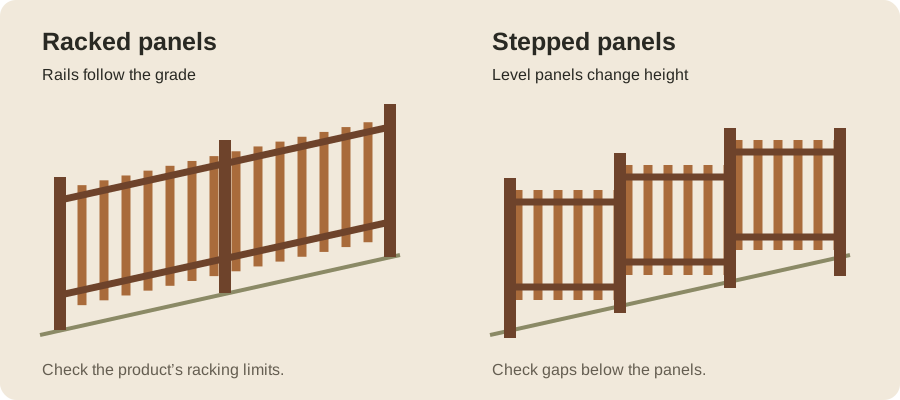
Racking versus stepping on a slope
A slope changes how panels meet grade. The two common approaches solve that differently, and the selected product decides what is possible.
Swipe across the table to compare all columns →
| Approach | How it works | Where it matters |
|---|---|---|
| Racking | Compatible panel rails follow grade while pickets stay upright. | Works only within the selected product's slope limits. |
| Stepping | Level panels change elevation in stages. | Can create larger bottom gaps and different gate clearance. |
02
Bottom gaps and small pets
Stepped layouts often leave larger bottom openings as the fence changes elevation. Racked layouts can reduce that gap, but product limits and grade still shape the final result.
Gate clearance also changes on grade. Review gap size with pet size, digging behavior, and how the gate will swing before choosing a layout.
03
Product limits and gate clearance
The best slope solution depends on the chosen fence system and where gates land on the grade. Ask these questions before the scope is final.
- Ask how the chosen product follows grade and where its racking limits stop.
- Confirm the bottom gap that remains after the selected step or rack method.
- Check gate clearance at the hinge, latch, and swing path.
- Confirm posts, hardware, and support details for the actual property.
- Ask for a layout that follows the selected manufacturer's slope and gate instructions.